• Architecting Legal Intelligence: A Week of Backend Refinement

    When building a platform that calculates and defends legal deadlines, every improvement matters. This week, I focused on strengthening the backend—making calculators more flexible, audit trails more robust, and narrative output more defensible.

    Here’s what changed, and why it matters.

    🔧 Flexible, Modular Calculators

    Calculators now handle the full lifecycle of legal deadline computation, including edge cases like discovery rules, minor tolling, and statutes of repose. They’re designed to adapt to different jurisdictions and case types without changing the core engine.

    Why it matters: This modularity allows the platform to scale efficiently while maintaining consistency and reliability. Testing, auditing, and client-specific adjustments are easier and safer.

    🗃️ Robust Audit Trails

    Every calculation now generates a persistent, queryable audit trail. This ensures that all decisions are traceable, making outcomes defensible and transparent for both internal review and client reporting.

    Why it matters: Lawyers and firms can rely on the platform to document how deadlines were calculated, reducing risk and providing clear evidence if questions arise.

    🧾 Explicit Handling of Discovery Logic

    The system now formally incorporates discovery rules, ensuring that all relevant legal considerations are applied consistently. This is critical for cases where the timing of claim awareness affects the outcome.

    Why it matters: Explicit handling of discovery logic reduces ambiguity and ensures defensible, consistent results for even the most nuanced cases.

    🧠 Narrative-Ready Output

    Each calculation produces structured outputs that can be transformed into client-facing explanations. Users get not only the deadlines but also clear reasoning behind them.

    Why it matters: Providing understandable narratives helps lawyers communicate confidently with clients and supports decision-making grounded in defensible logic.

    🧪 Comprehensive Testing

    Unit tests cover a wide range of scenarios, including edge cases, constraint enforcement, and consistency checks.

    Lesson learned: Strong automated testing safeguards both the integrity of calculations and the reliability of audit trails.

    🧭 Final Thought

    This week’s backend work may not be flashy, but it’s foundational. The system now guarantees that:

    • Calculators are flexible and jurisdiction-aware
    • Audit trails are persistent and transparent
    • Legal logic is applied consistently and defensibly
    • Outputs can be translated into clear, client-ready narratives

    In legal tech, the difference between “working” and “defensible” is everything. This backend doesn’t just calculate — it remembers, explains, and protects.

    About the Author

    My name is Paul A. Jones Jr., and I am a software engineer and legal tech founder developing tools for professionals in law and other regulated industries. I write about systems thinking, modern workflows, and SaaS applications at PaulJonesSoftware.com. Follow me on Twitter: @PaulAJonesJr.

    🔗 Related Posts

  • Understanding Legal Deadlines: From Case to Audit Trail

    Missing a filing deadline can jeopardize a case, client relationships, and firm reputation. For law firms, deadlines are critical; a single miss can end a case regardless of its merits. What is a legal deadline, and how does a solid audit trail help protect against these risks?

    📅 What Is a Legal Deadline?

    A legal deadline is any date by which a party must perform a specific legal action. Common examples include:

    • Filing a complaint or motion
    • Responding to a discovery request
    • Appealing a court decision

    Each deadline is governed by statutes, court rules, or contractual provisions. Even a one-day slip can trigger severe consequences—dismissal, sanctions, or malpractice exposure.

    💰 The Real Cost of Missing a Deadline

    The stakes are high. Industry data shows:

    • Average malpractice defense cost: $27,000+
    • Average settlement for missed-deadline claims: $300,000+

    These aren’t theoretical figures, they represent real financial exposure, reputational damage, and insurance implications for law firms.

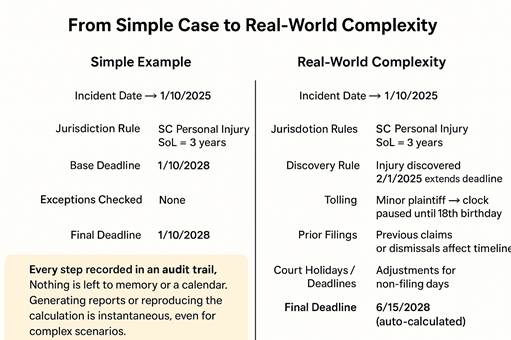
    🧪 Sample Case: Personal Injury Filing Deadline

    Scenario

    • Incident Date: January 10, 2025
    • Jurisdiction: South Carolina
    • Case Type: Personal Injury
    • Applicable Statute of Limitations: 3 years from incident date

    Step 1: Identify the Triggering Event

    • Incident date (January 10, 2025)

    Step 2: Apply Jurisdictional Rule

    • SC Personal Injury SoL = 3 years from incident date

    Step 3: Calculate Base Deadline

    • January 10, 2028

    Step 4: Check for Tolling or Exceptions

    • No minor plaintiffs
    • No discovery rule issues
    • No prior litigation tolls

    Step 5: Record Final Deadline

    • Filing must occur by January 10, 2028

    ⚠️ Note: This is a simplified example. Real-world cases often involve tolling provisions, discovery rules, multiple filings, and other factors that significantly increase the complexity of both calculation and tracking.

    📜 What a Legal Audit Trail Looks Like

    Unlike a calendar alert, a legal audit trail records every step of the deadline calculation. It’s a structured, time-stamped narrative that captures:

    StepData CapturedNotes
    Trigger EventIncident Date: 1/10/2025From case intake form
    Jurisdiction RuleSC Personal Injury SoL = 3 yearsVerified in statutory database
    Base Deadline1/10/2028Auto-calculated
    Exceptions CheckedNoneNo tolling applicable
    Final Deadline1/10/2028Locked for reference

    🛡️ Why It Matters

    • Defensibility: If a client challenges a filing date, you can show exactly how it was calculated.
    • Insurance & Compliance: Insurers reward documented, repeatable processes—premium benefits and risk reduction follow.
    • Automation: Each calculation generates this audit trail automatically, without additional admin work.
    • Risk Mitigation: A defensible record directly reduces exposure to malpractice claims.
    • Reproducibility: All data is stored securely — not locked in a filing cabinet or on a paralegal’s desktop. Reports, reviews, and replays are effortless.

    ✅ Key Takeaway

    A legal deadline is not just a date on a calendar. It’s a rule-driven calculation based on law, facts, and exceptions. Without a defensible audit trail, your firm is exposed to disputes, errors, and malpractice claims.

    True deadline management isn’t about reminders — it’s about evidence. Systems built for auditability transform deadlines from potential liabilities into verifiable assets, providing undeniable proof of compliance.

    📢 Strengthen Your Firm’s Deadline Management

    Every missed deadline carries financial, reputational, and compliance risks. Building defensible audit trails isn’t just about good practice management — it’s about protecting your clients and safeguarding your firm’s future.

    If your organization is ready to:

    • Reduce exposure to malpractice claims
    • Improve defensibility with documented audit trails
    • Modernize deadline tracking with automation and compliance in mind

    ➡️ Contact me to discuss how I can help. I work with law firms and legal teams to design and implement systems that transform deadlines from liabilities into verifiable assets.

    About the Author

    My name is Paul A. Jones Jr., and I am a software engineer and legal tech founder developing tools for professionals in law and other regulated industries. I write about systems thinking, modern workflows, and SaaS applications at PaulJonesSoftware.com. Follow me on Twitter: @PaulAJonesJr.

  • Dynamic Instantiation with Reflection: From Hardcoding to a Legal Deadline Platform

    When you’re building specialized software, there’s always a point where the old way of doing things starts to buckle under the weight of new requirements. For me, that point came when I realized I couldn’t keep hardcoding new calculators into the system.

    From Hardcoding to Dynamic Instantiation

    At first, each calculator was wired in by hand. If I needed a South Carolina personal injury calculator, I had to do something like this:

    var calculator = new SCPersonalInjuryCalculatorUtility();
    var result = calculator.CalculateDeadline(…);

    It worked, but the approach had obvious flaws. Every time I added a new calculator, I had to edit core code, duplicate boilerplate logic, and recompile the entire system. Scaling that way was going to be painful.

    The breakthrough came when I realized I could store the calculator’s fully qualified class name in the database and let the system resolve it at runtime. Now, the pattern looks like this:

    string className = repository.GetCalculatorName(caseTypeId, jurisdictionId);
    var calculator = CreateCalculator(className);
    var result = calculator.CalculateDeadline(…);

    Instead of hardcoding, I have a helper method that does three things:

    private ICalculatorUtility CreateCalculator(string className)
    {
    string assemblyName = "StatutePro.Calculator";
    string fullTypeName = $"{className}, {assemblyName}";
    Type calculatorType = Type.GetType(fullTypeName) 
        ?? throw new InvalidOperationException($"Type {fullTypeName} not found.");
    
    object instance = Activator.CreateInstance(calculatorType)!;
    
    if (instance is not ICalculatorUtility utility)
        throw new InvalidCastException($"{fullTypeName} does not implement ICalculatorUtility.");
    
    return utility;
    }

    This helper does all the heavy lifting:

    1. Retrieves the calculator’s class name from the database.
    2. Resolves the type dynamically with reflection.
    3. Guarantees that the new object implements ICalculatorUtility.

    In practice, it feels a lot like working with generics. The <T> in my solution is the calculator, and the shell takes care of everything else — logging, auditing, deadlines logic, and error handling.

    Understanding the Process: Dynamic Instantiation with Reflection

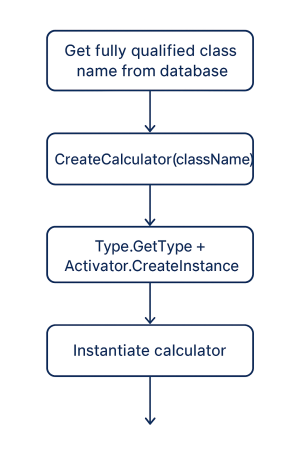
    Check out the flowchart below, which breaks down the process of dynamic instantiation with reflection on my legal deadline platform. From retrieving the fully qualified class name from the database to instantiating the calculator at runtime using Type.GetType and Activator.CreateInstance, this visual guide illustrates the seamless transition from hardcoding to a scalable, flexible solution.

    Dynamic Instantiation with Reflection

    Why This Matters

    This pattern unlocked three immediate benefits:

    • Seamless rollout: I can add or remove calculators live with minimal user impact.
    • Centralized logic: The shell handles all the cross-cutting concerns, so each new calculator only contains the unique rules.
    • Scalability: The system now supports tenant-specific calculators, exclusivity windows, and usage tracking — features that would have been nearly impossible under the old model.

    And there’s a bigger, more surprising benefit too: this approach lays the groundwork for an app store for legal deadlines.

    You’ve Built a Marketplace Without Realizing It

    Because calculators are now dynamically resolved, I don’t need to ship them all myself. Any qualified expert could contribute one — a law professor specializing in securities law, a litigation boutique that wants a medical malpractice calculator, or even a compliance consultant writing niche regulatory calculators.

    The system doesn’t care who wrote the calculator. As long as it implements the interface, the platform can load it. That’s the definition of a marketplace.

    • Contributors build calculators.
    • The platform hosts and manages them.
    • Users “install” (or subscribe to) the ones they need.
    • The business takes a cut.

    This isn’t just extensibility. This is the foundation of a legal deadline app store.

    Monetization Possibilities

    Dynamic instantiation transforms monetization from flat licensing into tiered, usage-based, and marketplace-driven models:

    • Pay-per-use: Usage counters tied to each calculator (already wired in via CalculatorUsage) make metered billing trivial.
    • Premium exclusivity: A tenant can have a custom calculator available only to them for a set period.
    • Revenue sharing: External experts could list calculators for sale, with the platform taking a percentage.
    • Analytics dashboards: Usage data feeds directly into client-facing dashboards showing activity, trends, and risk exposure.

    In other words: the same technical decision that solved my scaling problem also unlocked new revenue levers.

    Operational Advantages

    Beyond monetization, the pattern improves day-to-day operations:

    • Hot-swap capability: A buggy or outdated calculator can be disconnected instantly without downtime.
    • Rapid rollout: New calculators can go live without code changes or redeployment.
    • Centralized debugging: Core logic stays in the shell, so any issues are fixed once and propagate everywhere.

    That’s a massive efficiency gain when the system grows from a handful of calculators to hundreds.

    Next Steps

    The foundation is now in place. The next steps are:

    • Formalize the factory API so it’s production-ready.
    • Build tooling for publishing and managing calculators (versioning, testing, approvals).
    • Explore pilot programs with external experts to test the marketplace model.
    • Wire up detailed usage tracking for both global Count and per-tenant CalculatorUsage.

    It’s rare when a single technical pattern reshapes both the product roadmap and the business strategy. Reflection did that for me.

    This approach doesn’t just solve a technical problem — it opens the door to scalable growth, new revenue models, and operational resilience.

    About the Author

    My name is Paul A. Jones Jr., and I am a software engineer and legal tech founder developing tools for professionals in law and other regulated industries. I write about systems thinking, modern workflows, and SaaS applications at PaulJonesSoftware.com. Follow me on Twitter: @PaulAJonesJr.

  • Learning by Coding

    Most people learn law through textbooks, lectures, or practice. I’m learning it by writing code.

    Every statute of limitations rule I add to my Legal Deadline Engine starts as a vague legal principle and ends as something concrete: a database record, a calculation, an audit trail. The process of translating doctrine into logic is where the real learning happens.

    Daily Practice: One Term at a Time

    To keep myself honest, I started a self-training routine: each day I document one statute of limitations term in plain language. “Tolling,” “Discovery Rule,” “Equitable Estoppel” — every term gets broken down, defined, and then tested against actual code in the engine.

    It’s like a mini law school curriculum, but instead of lectures, I’ve got unit tests.

    Why Coding Forces Clarity

    You can’t hide behind abstractions when you’re coding. If a rule says, “The deadline is three years from the date of discovery,” the computer forces you to answer:

    • What exactly counts as “discovery”?
    • What happens if there’s more than one possible trigger date?
    • How do tolling events interrupt the calculation?

    Suddenly, you’re not just reading the rule — you’re interrogating it, step by step, until it works in real life.

    From Function to Feedback

    What surprises me most is how coding creates instant feedback loops. Write a rule wrong? The deadline comes out wrong. Forget an exception? The audit trail tells you.

    Each bug or edge case isn’t a failure — it’s another lesson in how the law actually operates. And once I’ve coded it, I know I understand it better than if I’d just memorized it.

    Why This Matters

    For me, this isn’t just about building software. It’s about building expertise. By the time I’m done, I won’t just have a Legal Deadline Engine. I’ll have a deep, working knowledge of statutes of limitations that came not from a classroom, but from the discipline of daily study + executable code.

    Takeaway

    If you really want to master something — whether it’s law, math, or physics — try pairing daily bite-sized study with coding. Computers are unforgiving teachers. They won’t let you gloss over the gray areas.

    Learning by coding doesn’t just build software. It builds understanding.

    About the Author

    My name is Paul A. Jones Jr., and I am a software engineer and legal tech founder developing tools for professionals in law and other regulated industries. I write about systems thinking, modern workflows, and SaaS applications at PaulJonesSoftware.com. Follow me on Twitter: @PaulAJonesJr.

  • Asset-Based Consulting: The Force Multiplier for Professionals

    Most professional service firms today grow the same way they always have: by adding more people. More associates, more consultants, more staff. While that model works, it’s expensive, slow, and sometimes inefficient.

    Enter Asset-Based Consulting (ABC).

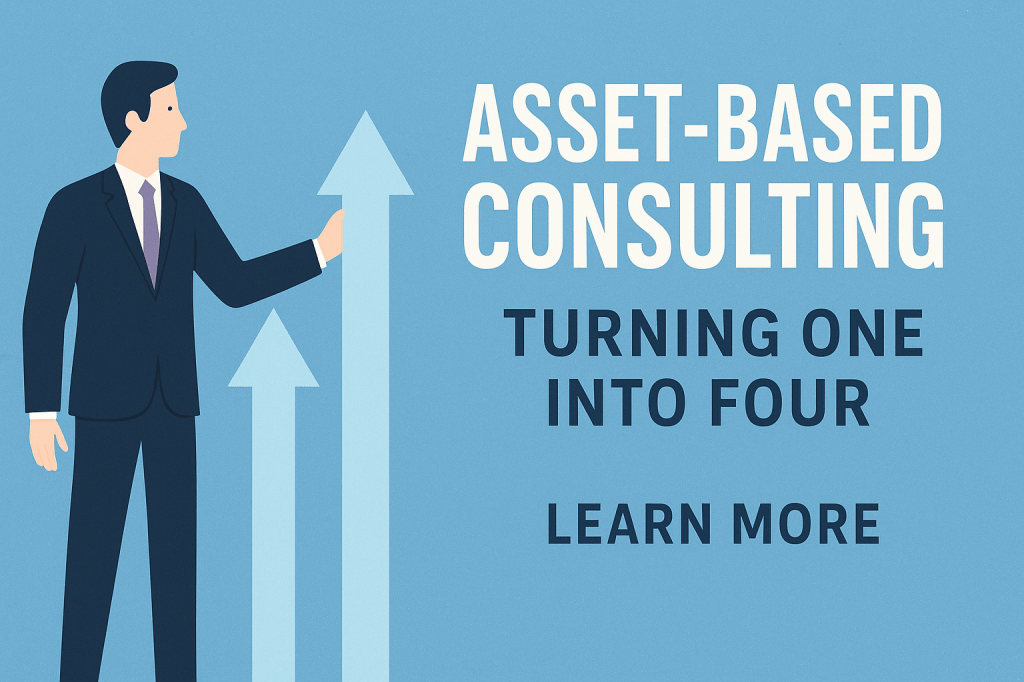
    Unlike traditional consulting, which scales linearly by hiring more human resources, ABC leverages software assets to multiply the impact of each professional. Think of it as adding an automated workforce capability to your practice — without the overhead of onboarding, training, or managing new hires.

    For independent contract developers like me, ABC has been the force multiplier I’ve been seeking for years. Imagine this: an engineer who normally averages $70/hour suddenly has a platform that enables him to generate $300/hour. Not by working harder or longer, but by leveraging reusable, automated assets that extend his capabilities.

    It’s like turning one professional into a full-time, four-person firm. That’s the power of asset-based consulting.

    Why It Matters

    The concept isn’t just theory. Major players are already recognizing and advancing ABC as the future of professional services.

    IBM describes asset-based consulting as a model where firms use proprietary tools, technologies, and methods to deliver solutions more efficiently and effectively to clients. This approach enables consultants to apply technology-enabled tools, products, and AI-trained models to support their services, enhancing scalability and long-term value (IBM on Asset-Based Consulting).

    Deloitte emphasizes the importance of combining industry knowledge with deep technical expertise to help clients reimagine human-centric businesses for today and tomorrow. Their consulting services leverage advanced technologies and industry insights to create impactful solutions tailored to unique needs, accelerating growth, innovation, and enduring value creation (Deloitte Consulting Services).

    This approach is gaining momentum because it solves a real problem: how do professionals and firms grow without burning out talent or inflating overhead? The answer lies in reusable digital assets — from automated calculators to dashboards to compliance engines — that deliver repeatable value at a fraction of traditional cost.

    What It Looks Like in Practice

    In my own consulting practice, I’ve been developing what I call a Legal Deadline Engine (LDE). It’s a software platform that automates statute-driven calculations, audit trails, and reporting. Where a traditional paralegal team might spend hours manually computing timelines, the LDE can produce consistent, documented outputs in seconds.

    That’s ABC in action: taking what used to be pure manual effort and transforming it into an asset that generates recurring, scalable value.

    Where This Can Go

    The exciting part? ABC isn’t limited to legal tech. Finance, healthcare, compliance, insurance, and countless other sectors all depend on rules-based, repeatable processes that can be automated. Once professionals realize they don’t just sell time, but also codified expertise, entire industries could be reshaped.

    Call to Action

    If this idea resonates with you — whether you’re a consultant, lawyer, engineer, or entrepreneur — I’d love to have a conversation. Reach out to me directly if you’re interested in exploring how Asset-Based Consulting could transform your practice or organization.

    Relevant Links

    About the Author

    My name is Paul A. Jones Jr., and I am a software engineer and legal tech founder developing tools for professionals in law and other regulated industries. I write about systems thinking, modern workflows, and SaaS applications at PaulJonesSoftware.com. Follow me on Twitter: @PaulAJonesJr.

  • When Rules Collide: Designing a Class to Break Legal Deadline Ties

    If you’ve ever tried to calculate a legal filing deadline, you know it’s not as simple as “incident date + X years.” In many cases, multiple rules apply — each with its own logic, timelines, and exceptions.

    That’s where the fun begins.

    Imagine a single case producing three possible deadlines:

    • Occurrence rule: X years from the date of the incident.
    • Discovery rule: X years from when the harm was (or should have been) discovered.
    • Statute of repose: An absolute cutoff date, regardless of discovery or occurrence.

    Each of these is designed to serve a purpose, but together, they can create conflicting results. Which one wins?

    The Tie-Breaker Problem

    In real-world practice, the “winning” deadline depends on jurisdiction and statute language. Sometimes the earliest date controls (“earliest wins” rule). Other times, discovery may extend the timeline unless a repose period cuts it off.

    If you hard-code these decisions in every calculator, you’re setting yourself up for chaos. Change the tie-breaking logic once, and suddenly you’re hunting through multiple files, hoping you didn’t miss anything.

    Enter the Utility Class

    To solve this, I created a calculator utility class that:

    1. Applies each rule independently — occurrence, discovery, repose, and others.
    2. Normalizes the results into a common format.
    3. Determines the effective deadline based on the jurisdiction’s tie-breaking rule.

    By isolating this logic:

    • The calculators stay lean and readable.
    • Tie-breaking behavior is consistent across all practice areas.
    • New rules (or rule combinations) can be added without rewriting everything.

    Why It Works

    • Centralization – One place to change core date-comparison logic.
    • Transparency – Easy to explain why a deadline was chosen over another.
    • Testability – Unit tests can target the decision-making engine directly.

    In short, the utility class became the “referee” — applying the law’s rules in order, then declaring the winner without bias.

    The Bigger Picture

    This approach isn’t just for statutes of limitations. Any system where multiple time-based rules can apply — contract expirations, compliance deadlines, insurance claims — can benefit from the same pattern.

    When rules collide, it’s not enough to calculate dates. You need a consistent, tested, and explainable way to decide which date matters most.

    And that’s why my utility class isn’t just a helper. It’s the judge, jury, and timekeeper.

    Thanks for reading!

    About the Author

    Paul A. Jones Jr. is a software engineer and legal tech founder developing tools for professionals in law and other regulated industries. He writes about systems thinking, modern workflows, and SaaS applications at PaulJonesSoftware.com. Follow him on Twitter: @PaulAJonesJr.

    You Might Also Enjoy

  • Drawing the Line: How I Decide What to Offer via SaaS vs. Consulting

    When you build a specialized legal tech platform, one of the hardest decisions isn’t the tech stack or the UI — it’s deciding what belongs in the self-service product and what should stay in direct consulting engagements.

    At first glance, the temptation is to make everything available in software. It feels generous, scalable, and client-friendly. But in practice, this can create real problems — for both the client and the business.

    Over the past few months, I’ve been shaping my Legal Deadline Engine with two clear “lanes”:

    Lane 1: SaaS (Self-Service)

    These are the core features every subscriber can access:

    • Standard legal deadline calculators
    • Clear, exportable reports
    • Simple replay and history tools
    • Regular automated rule updates
    • Team collaboration with basic role management

    These features are predictable, repeatable, and valuable without requiring deep customization. They’re designed for speed, consistency, and accessibility.

    Lane 2: Consulting (Custom & Premium)

    These are reserved for direct engagements with firms:

    • Custom calculators for niche or multi-jurisdictional needs
    • Certified forensic reports and expert analysis
    • Tailored workflow integrations into firm-specific systems
    • Advanced analytics and risk scoring
    • Priority access to new or experimental features

    These aren’t “locked away” to force upsells — they’re separated because they require expertise, judgment, and close collaboration to get right. Delivering them as consulting ensures accuracy, compliance, and client-specific adaptation.

    Why This Matters

    In legal tech, not all complexity should be automated away. Some problems are too nuanced, too context-dependent, or too high-stakes to hand off to a self-service tool. By drawing a clear line between SaaS and consulting:

    • Clients get the best of both worlds — instant access for common tasks, expert help for the edge cases.
    • The platform stays reliable and focused.
    • My consulting work retains its value as a premium, high-touch service.

    The lesson here? Innovation isn’t about doing everything in software. It’s about knowing what software should handle — and when a human expert should step in.

    If you’re curious about what your firm could achieve with the consulting lane, let’s talk.

    Thanks for reading!

    About the Author

    My name is Paul A. Jones Jr., and I am a software engineer and legal tech founder developing tools for professionals in law and other regulated industries. I write about systems thinking, modern workflows, and SaaS applications at PaulJonesSoftware.com. Follow me on Twitter: @PaulAJonesJr.

  • How a Single Composite Context Transformed My Calculator Architecture

    As software engineers, we often face the same problem over and over again: managing a growing number of dependencies across multiple classes that share similar—but slightly different—needs.

    Today, I want to share a small but impactful refactor I did while developing a SaaS platform that performs complex deadline calculations across various business rules and jurisdictions. This refactor cleaned up my calculator classes and made the platform easier to maintain and extend.

    The Problem: Constructor Hell & Fragile Dependency Passing

    Initially, each calculator in the platform needed several dependencies injected to operate properly—things like database connection strings, audit logging contexts, repositories, and logger services.

    Here’s what the constructor looked like for one of my calculators:

    // C# code

    MedicalMalpracticeCalculator medMalCalc =
    new MedicalMalpracticeCalculator(_connectionString, _auditLogContext!, _loggerService!);

    Sounds simple? Maybe, until I started adding more dependencies and more calculators:

    • The constructors became long and unwieldy.
    • Every time I added a new dependency, I had to update every calculator signature and all their call sites.
    • Unit tests bloated with repeated setup code for each dependency.
    • Code duplication crept in across calculators, violating the DRY principle.

    This scenario is common in many projects—dependency management quickly becomes a tangled mess, especially as systems grow in complexity.

    The Solution: Introducing CalculatorContext

    I realized that all calculators basically needed the same core set of dependencies. So why not bundle them into a single composite object? Enter:

    public class CalculatorContext
    {
    public string ConnectionString { get; }
    public IAuditLogContext AuditLogContext { get; }
    public ILoggerService LoggerService { get; }
    public IRuleRepository RuleRepository { get; }
    // More dependencies as needed…

    // Constructor to instantiate all dependencies once
    public CalculatorContext(string connectionString, IAuditLogContext auditLogContext, ILoggerService loggerService, IRuleRepository ruleRepository)
    {
    ConnectionString = connectionString;
    AuditLogContext = auditLogContext;
    LoggerService = loggerService;
    RuleRepository = ruleRepository;
    }

    }

    Now, the calculator constructors only accept one parameter:

    MedicalMalpracticeCalculator medMalCalc =
    new MedicalMalpracticeCalculator(calculatorContext);

    The Magic: Base Calculator Unpacks the Context

    I didn’t stop there. All calculators inherit from a base class. So I changed the base calculator constructor to accept the CalculatorContext and unpack dependencies inside it:

    public abstract class BaseCalculator
    {
    protected readonly IAuditLogContext AuditLogContext;
    protected readonly ILoggerService LoggerService;
    protected readonly IRuleRepository RuleRepository;


    protected BaseCalculator(CalculatorContext context)
    {
    AuditLogContext = context.AuditLogContext;
    LoggerService = context.LoggerService;
    RuleRepository = context.RuleRepository;
    }
    }

    Because the rest of the calculator code already referenced these protected fields, no other code needed to change. This was a huge win—it meant my refactor was isolated and non-disruptive.

    The Benefits: Cleaner, More Maintainable, More Scalable

    This simple refactor brought immediate and long-term benefits:

    • Cleaner code: Calculator constructors are simple, uniform, and less noisy.
    • Standardized instantiation: All calculators are created the same way, reducing confusion.
    • Single source of truth: One place to add or change dependencies, minimizing duplication and errors.
    • Slimmer unit tests: Test fixtures no longer need to mock or set up dozens of parameters repeatedly.
    • Easy scaling: Adding new calculators or dependencies is now much easier.
    • Future-proof: The platform is now better prepared for dependency injection frameworks or factory patterns, should I choose to adopt them later.

    Takeaway for Fellow Developers

    If you’re managing multiple classes that share a common set of dependencies—especially if those dependencies grow over time—consider wrapping them in a context or configuration object.

    Pair that with a well-designed base class that unpacks the dependencies and provides protected fields or properties to derived classes.

    This pattern can drastically reduce constructor bloat, improve testability, and make your codebase more maintainable and scalable.

    Final Thoughts

    Refactoring for maintainability often feels like a chore, but it’s these little wins that compound over time and make a huge difference.

    Today, my calculator classes feel lighter, clearer, and more robust—and I’m ready to tackle adding new rules and jurisdictions with confidence.

    If you’ve faced similar struggles or found other neat ways to manage dependencies in your projects, I’d love to hear about them!

    Thanks for reading!

    About the Author

    My name is Paul A. Jones Jr., and I am a software engineer and legal tech founder developing tools for professionals in law and other regulated industries. I write about systems thinking, modern workflows, and SaaS applications at PaulJonesSoftware.com. Follow me on Twitter: @PaulAJonesJr.

  • What Event Tolling Taught Me About Data Integrity

    One of the more interesting features I recently built into a legal software application was support for event tolling—a process used to pause countdown timers in legal workflows when certain conditions are met. On paper, it’s just a date adjustment. In reality, it’s a complex, high-stakes chain of logic that affects deadlines, rights, and outcomes.

    But what I didn’t expect was how much this feature would deepen my thinking about data integrity, automation, and design.

    The Original Flaw: Manual Recalculation

    In the original design, the process went something like this:

    1. A user added a qualifying event that should pause a legal deadline.
    2. The event was saved.
    3. A separate method existed to update the related deadline—but it had to be triggered manually.

    This worked fine in the short term… until I asked myself:

    “What happens if I forget to call that update method somewhere down the line?”

    The answer, of course, was data drift—calculated deadlines becoming inaccurate because the update logic wasn’t enforced. That’s not just a technical bug. In a legal context, it’s a potential compliance issue.

    The Fix: Automate or Fail

    The fix was obvious but essential: embed the recalculation directly into the method that adds the tolling event. From now on, when a tolling event is saved, it automatically triggers a deadline update on the related record.

    I updated the repository layer, added the dependency injection needed, and adjusted the interface. Then I wrote a fresh unit test to prove the whole thing worked:

    • Create a test record
    • Apply a tolling event that pauses time for 10 days
    • Verify that the new deadline reflects that 10-day pause
    • Assert the math checks out

    The test passed, the design got cleaner, and I slept better.

    System Integrity Starts with Enforcement

    Here’s the broader principle I took away from all of this:

    If your application depends on humans remembering to do something critical, your system is already broken.

    If it’s vital—whether for financials, compliance, workflow timing, or audit trail reasons—then it must be automated, not optional.

    One More Thing: Make a Default System User

    There was one last loose end. The update logic requires a userId to track who made the change. In this case, since the system itself was making the change, I needed a clean solution.

    So I created a default system user (User ID = 1). Every automated update can now be attributed to that account, preserving accountability and audit trail consistency without faking human involvement.

    It’s a small detail, but in long-lived software, these little decisions pay dividends later.

    Final Thoughts

    Event tolling is a complex concept—especially in legal tech—but the biggest lesson wasn’t about business logic. It was about defensive architecture.

    If your system supports cascading updates, interdependent data, or audit-sensitive workflows, don’t rely on hope or habit. Enforce the outcome. Automate the linkage. Test the entire pipeline.

    Because the moment you forget to update one field, someone else might notice. And they won’t assume it’s just a minor bug.

    About the Author

    My name is Paul A. Jones Jr., and I am a software engineer and legal tech founder developing tools for professionals in law and other regulated industries. I write about systems thinking, modern workflows, and SaaS applications at PaulJonesSoftware.com. Follow me on Twitter: @PaulAJonesJr.

  • The Tea App Fiasco: Data Breach, Public Shaming, and a Culture on Fire

    72,000 identities exposed—and the irony runs deep.

    There’s something darkly poetic about what happened with the Tea App.

    Billed as a place to spill secrets, vent frustrations, and share personal truths under the comforting blanket of anonymity, it quickly became a hotspot for gossip, confessions, and—let’s be honest—cruelty. People used it to air dirty laundry, call others out by name, and broadcast the kind of content they’d never have the courage to say aloud in public. The app leaned hard into the promise of anonymity, and for a while, that illusion held.

    Until it didn’t.

    A massive data breach exposed the personal information of more than 72,000 users. Not just their usernames or hashed credentials—but the posts themselves, linked to real identities. Suddenly, the people doing the whispering were being shouted about. The ones who’d made others feel unsafe weren’t feeling so safe anymore.

    It was the digital grapevine snapping in real time.

    Designed for Secrets, Built Without Safety

    The breach didn’t just reveal personal data. It revealed a design flaw in the very idea of the app: it asked for trust it didn’t earn.

    Users were led to believe that anonymity meant immunity. That the digital walls were thick enough to hold their secrets. But anonymity isn’t a feature you toggle—it’s a responsibility you build for. And in this case, it wasn’t built at all.

    The exposed data was sitting on a publicly accessible Firebase server. No encryption. No access controls. Just sitting there, waiting for someone to find it. That’s not a tech slip-up. That’s negligence.

    Gossip at the Speed of Light

    Let’s call this what it really is: a high-tech version of the old-fashioned rumor mill. We’ve seen it before—just not with this much bandwidth.

    In the past, whispers traveled by word of mouth. Maybe a phone call, maybe a note passed in class, maybe a bar conversation. But now? Now it’s global. Instant. Persistent. Indexed by search engines and scraped by bots. The grapevine has grown fiber optic roots.

    And the consequences are permanent.

    Users weren’t just name-dropping. They were uploading photos of the people they were targeting—often without consent. Some posts read like petty revenge, others like full-blown character assassination. It was Yelp for men, but without due process or moderation. Real faces. Real names. Public judgment without context.

    “It was Yelp for men, but without due process or moderation. Real faces. Real names. Public judgment without context.”

    And now? The tables have turned.

    The same users who helped popularize this culture of exposure are suddenly begging for privacy. The photos they uploaded to prove they were women—some filtered, some explicit, all assumed to be safe—are now being passed around the internet, mocked, memed, and dissected in the exact ways they once weaponized.

    All of this took place at the corner of Vibe, Dox, and Tea App Streets—where clout-chasing meets digital vigilantism, and nobody walks away clean. It wasn’t just a data breach. It was a cultural collision—part gossip, part vengeance, part tech naïveté—and the wreckage speaks for itself.

    The Bigger Picture: Pouring Gas on a Cultural Fire

    Let’s zoom out.

    The Tea App didn’t just expose private data—it exposed something deeper: the state of a society already straining under mistrust.

    In a country with a declining birth rate, where many men don’t trust women and many women don’t trust men, this was the last thing we needed. You already have MGTOW, Passport Bros, SYSBM, Red Pill, MeToo—entire ecosystems built around the idea that men and women are increasingly incompatible, or even adversarial.

    The Tea App didn’t heal any of that. It made it worse.

    It gave people a platform to publicly shame and accuse others under a cloak of anonymity, amplifying conflict instead of resolving it. What may have felt empowering for some became deeply destructive for others. In a society already teetering, it threw gas on an open flame.

    Public shaming is not accountability. And anonymous attacks aren’t progress. The result wasn’t discourse. It was damage.

    What We Should Learn from This

    The Tea App wasn’t just a product failure. It was a cultural one.

    It capitalized on our worst instincts and gave them a frictionless delivery mechanism. It made gossip feel like entertainment, and personal attacks feel like content. It encouraged people to behave badly behind masks, and then failed to protect the masks themselves.

    For developers, founders, and anyone working on social products, here’s the takeaway:
    If your app revolves around trust, you don’t get to treat security like an afterthought.

    And for users:
    If it feels too easy to be anonymous, it’s probably not anonymous at all.

    Final Thoughts

    The Tea App promised users a way to speak freely without consequences. Instead, it delivered one of the most glaring public examples of digital betrayal in recent memory.

    It’s easy to dismiss it as just another failed startup, but that misses the point. This was a platform designed around secrets—and it couldn’t even keep its own.

    The grapevine is still alive and well. But these days, it’s wired, searchable, and dangerously flammable.

    About the Author

    My name is Paul A. Jones Jr., and I am a software engineer and legal tech founder developing tools for professionals in law and other regulated industries. I write about systems thinking, modern workflows, and SaaS applications at PaulJonesSoftware.com. Follow me on Twitter: @PaulAJonesJr.