

Missing a filing deadline can jeopardize a case, client relationships, and firm reputation. For law firms, deadlines are critical; a single miss can end a case regardless of its merits. What is a legal deadline, and how does a solid audit trail help protect against these risks?
📅 What Is a Legal Deadline?
A legal deadline is any date by which a party must perform a specific legal action. Common examples include:
- Filing a complaint or motion
- Responding to a discovery request
- Appealing a court decision
Each deadline is governed by statutes, court rules, or contractual provisions. Even a one-day slip can trigger severe consequences—dismissal, sanctions, or malpractice exposure.
💰 The Real Cost of Missing a Deadline
The stakes are high. Industry data shows:
- Average malpractice defense cost: $27,000+
- Average settlement for missed-deadline claims: $300,000+
These aren’t theoretical figures, they represent real financial exposure, reputational damage, and insurance implications for law firms.
🧪 Sample Case: Personal Injury Filing Deadline
Scenario
- Incident Date: January 10, 2025
- Jurisdiction: South Carolina
- Case Type: Personal Injury
- Applicable Statute of Limitations: 3 years from incident date
Step 1: Identify the Triggering Event
- Incident date (January 10, 2025)
Step 2: Apply Jurisdictional Rule
- SC Personal Injury SoL = 3 years from incident date
Step 3: Calculate Base Deadline
- January 10, 2028
Step 4: Check for Tolling or Exceptions
- No minor plaintiffs
- No discovery rule issues
- No prior litigation tolls
Step 5: Record Final Deadline
- Filing must occur by January 10, 2028
⚠️ Note: This is a simplified example. Real-world cases often involve tolling provisions, discovery rules, multiple filings, and other factors that significantly increase the complexity of both calculation and tracking.
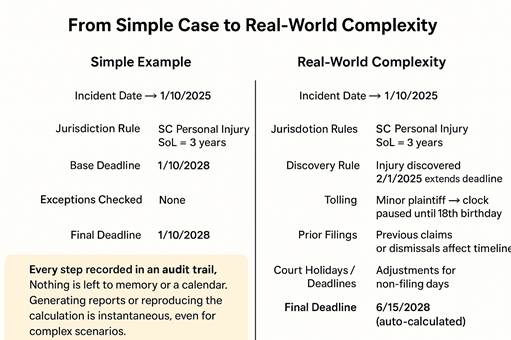
📜 What a Legal Audit Trail Looks Like
Unlike a calendar alert, a legal audit trail records every step of the deadline calculation. It’s a structured, time-stamped narrative that captures:
| Step | Data Captured | Notes |
| Trigger Event | Incident Date: 1/10/2025 | From case intake form |
| Jurisdiction Rule | SC Personal Injury SoL = 3 years | Verified in statutory database |
| Base Deadline | 1/10/2028 | Auto-calculated |
| Exceptions Checked | None | No tolling applicable |
| Final Deadline | 1/10/2028 | Locked for reference |
🛡️ Why It Matters
- Defensibility: If a client challenges a filing date, you can show exactly how it was calculated.
- Insurance & Compliance: Insurers reward documented, repeatable processes—premium benefits and risk reduction follow.
- Automation: Each calculation generates this audit trail automatically, without additional admin work.
- Risk Mitigation: A defensible record directly reduces exposure to malpractice claims.
- Reproducibility: All data is stored securely — not locked in a filing cabinet or on a paralegal’s desktop. Reports, reviews, and replays are effortless.
✅ Key Takeaway
A legal deadline is not just a date on a calendar. It’s a rule-driven calculation based on law, facts, and exceptions. Without a defensible audit trail, your firm is exposed to disputes, errors, and malpractice claims.
True deadline management isn’t about reminders — it’s about evidence. Systems built for auditability transform deadlines from potential liabilities into verifiable assets, providing undeniable proof of compliance.
📢 Strengthen Your Firm’s Deadline Management
Every missed deadline carries financial, reputational, and compliance risks. Building defensible audit trails isn’t just about good practice management — it’s about protecting your clients and safeguarding your firm’s future.
If your organization is ready to:
- Reduce exposure to malpractice claims
- Improve defensibility with documented audit trails
- Modernize deadline tracking with automation and compliance in mind
➡️ Contact me to discuss how I can help. I work with law firms and legal teams to design and implement systems that transform deadlines from liabilities into verifiable assets.
About the Author
My name is Paul A. Jones Jr., and I am a software engineer and legal tech founder developing tools for professionals in law and other regulated industries. I write about systems thinking, modern workflows, and SaaS applications at PaulJonesSoftware.com. Follow me on Twitter: @PaulAJonesJr.
 Paul Jones Software
Leave a comment