
72,000 identities exposed—and the irony runs deep.
There’s something darkly poetic about what happened with the Tea App.
Billed as a place to spill secrets, vent frustrations, and share personal truths under the comforting blanket of anonymity, it quickly became a hotspot for gossip, confessions, and—let’s be honest—cruelty. People used it to air dirty laundry, call others out by name, and broadcast the kind of content they’d never have the courage to say aloud in public. The app leaned hard into the promise of anonymity, and for a while, that illusion held.
Until it didn’t.
A massive data breach exposed the personal information of more than 72,000 users. Not just their usernames or hashed credentials—but the posts themselves, linked to real identities. Suddenly, the people doing the whispering were being shouted about. The ones who’d made others feel unsafe weren’t feeling so safe anymore.
It was the digital grapevine snapping in real time.
Designed for Secrets, Built Without Safety
The breach didn’t just reveal personal data. It revealed a design flaw in the very idea of the app: it asked for trust it didn’t earn.
Users were led to believe that anonymity meant immunity. That the digital walls were thick enough to hold their secrets. But anonymity isn’t a feature you toggle—it’s a responsibility you build for. And in this case, it wasn’t built at all.
The exposed data was sitting on a publicly accessible Firebase server. No encryption. No access controls. Just sitting there, waiting for someone to find it. That’s not a tech slip-up. That’s negligence.
Gossip at the Speed of Light
Let’s call this what it really is: a high-tech version of the old-fashioned rumor mill. We’ve seen it before—just not with this much bandwidth.
In the past, whispers traveled by word of mouth. Maybe a phone call, maybe a note passed in class, maybe a bar conversation. But now? Now it’s global. Instant. Persistent. Indexed by search engines and scraped by bots. The grapevine has grown fiber optic roots.
And the consequences are permanent.
Users weren’t just name-dropping. They were uploading photos of the people they were targeting—often without consent. Some posts read like petty revenge, others like full-blown character assassination. It was Yelp for men, but without due process or moderation. Real faces. Real names. Public judgment without context.
“It was Yelp for men, but without due process or moderation. Real faces. Real names. Public judgment without context.”
And now? The tables have turned.
The same users who helped popularize this culture of exposure are suddenly begging for privacy. The photos they uploaded to prove they were women—some filtered, some explicit, all assumed to be safe—are now being passed around the internet, mocked, memed, and dissected in the exact ways they once weaponized.
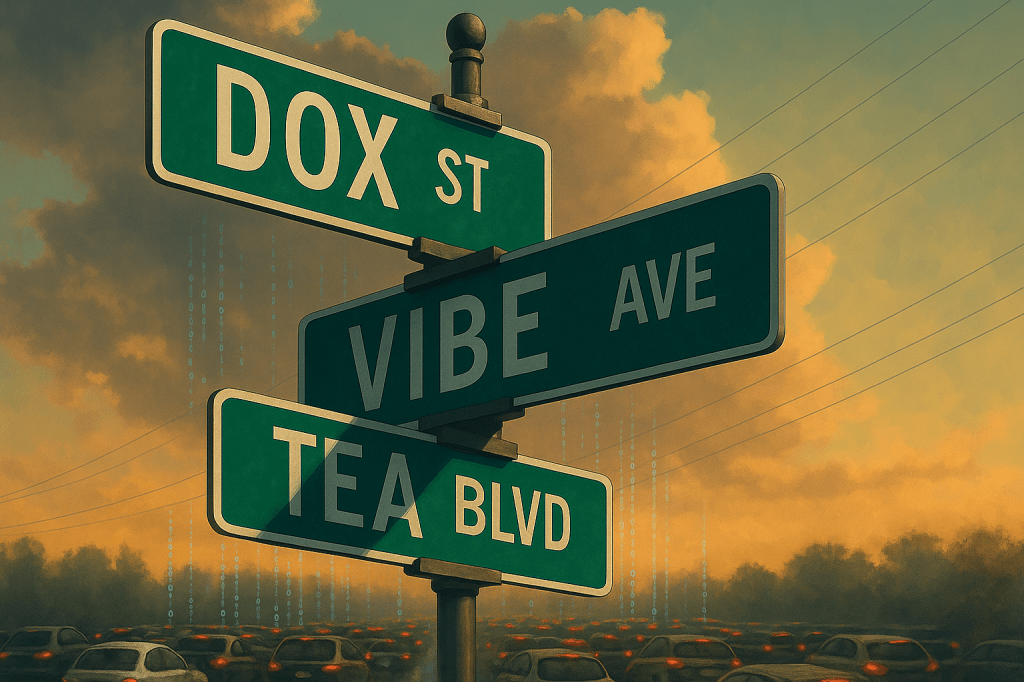
All of this took place at the corner of Vibe, Dox, and Tea App Streets—where clout-chasing meets digital vigilantism, and nobody walks away clean. It wasn’t just a data breach. It was a cultural collision—part gossip, part vengeance, part tech naïveté—and the wreckage speaks for itself.
The Bigger Picture: Pouring Gas on a Cultural Fire
Let’s zoom out.
The Tea App didn’t just expose private data—it exposed something deeper: the state of a society already straining under mistrust.
In a country with a declining birth rate, where many men don’t trust women and many women don’t trust men, this was the last thing we needed. You already have MGTOW, Passport Bros, SYSBM, Red Pill, MeToo—entire ecosystems built around the idea that men and women are increasingly incompatible, or even adversarial.
The Tea App didn’t heal any of that. It made it worse.
It gave people a platform to publicly shame and accuse others under a cloak of anonymity, amplifying conflict instead of resolving it. What may have felt empowering for some became deeply destructive for others. In a society already teetering, it threw gas on an open flame.
Public shaming is not accountability. And anonymous attacks aren’t progress. The result wasn’t discourse. It was damage.
What We Should Learn from This
The Tea App wasn’t just a product failure. It was a cultural one.
It capitalized on our worst instincts and gave them a frictionless delivery mechanism. It made gossip feel like entertainment, and personal attacks feel like content. It encouraged people to behave badly behind masks, and then failed to protect the masks themselves.
For developers, founders, and anyone working on social products, here’s the takeaway:
If your app revolves around trust, you don’t get to treat security like an afterthought.
And for users:
If it feels too easy to be anonymous, it’s probably not anonymous at all.
Final Thoughts
The Tea App promised users a way to speak freely without consequences. Instead, it delivered one of the most glaring public examples of digital betrayal in recent memory.
It’s easy to dismiss it as just another failed startup, but that misses the point. This was a platform designed around secrets—and it couldn’t even keep its own.
The grapevine is still alive and well. But these days, it’s wired, searchable, and dangerously flammable.
About the Author
My name is Paul A. Jones Jr., and I am a software engineer and legal tech founder developing tools for professionals in law and other regulated industries. I write about systems thinking, modern workflows, and SaaS applications at PaulJonesSoftware.com. Follow me on Twitter: @PaulAJonesJr.
 Paul Jones Software
Leave a comment