
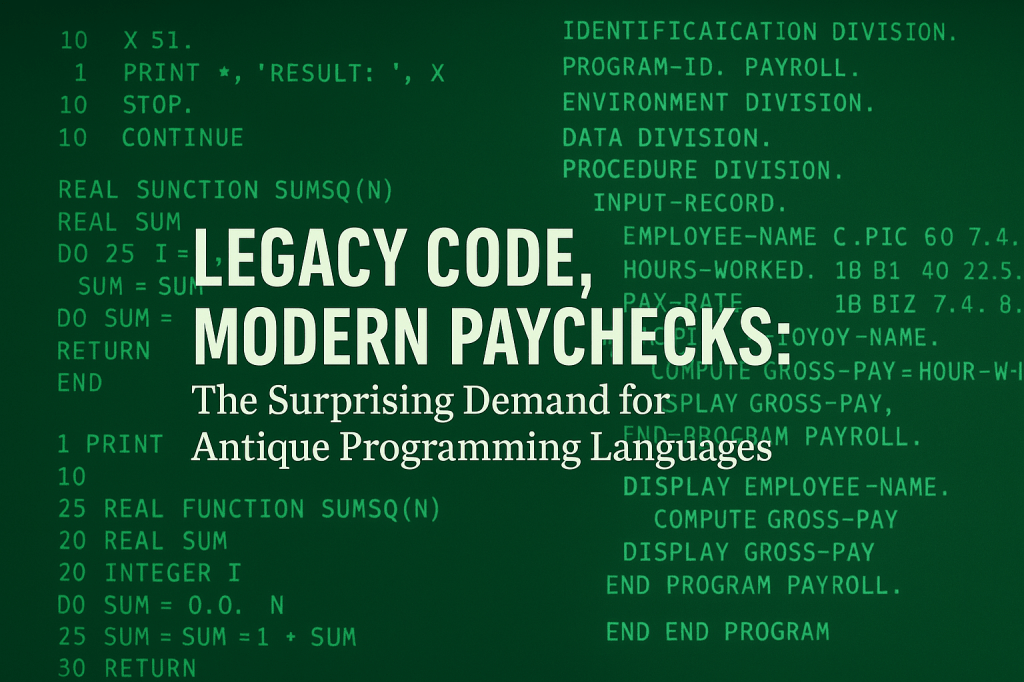
Why old-school tech skills like COBOL and Fortran are still landing high-paying gigs in 2025
In a tech world obsessed with the latest frameworks and cutting-edge AI, it might surprise you to learn there’s still an active – and even lucrative – market for what many would call antique programming languages. We’re talking COBOL, Fortran, Ada, LISP, and other veterans of computing history. But is there really a need for these languages in 2025? And more importantly – can IT contractors and recruiters tap into this niche?
The short answer: Absolutely.
Let’s dig into why.
Why “Dead” Languages Still Matter
While Silicon Valley startups might not be spinning up Fortran microservices, major industries like banking, insurance, government, and aerospace still rely heavily on legacy systems. These systems were built decades ago in languages that modern devs consider obsolete—but they’re still running critical operations today.
In fact, entire Fortune 500 companies continue to rely on mainframes programmed in COBOL and supported by a dwindling number of seasoned developers. Rewriting or replacing these systems would be costly, risky, and time-consuming, so they live on.
That creates a unique opportunity for:
- Experienced developers who already know these languages.
- Younger devs willing to learn them and fill the talent gap.
- IT recruiters who can source and place hard-to-find talent in high-paying roles.
Who’s Hiring?
You’d be surprised how often antique programming skills are in demand. Here are just a few examples:
- Banks & Financial Institutions: COBOL still processes trillions of dollars in daily transactions.
- Government Agencies: From the IRS to state unemployment systems, legacy code is everywhere.
- Aerospace & Defense Contractors: Mission-critical systems often run on ADA or Fortran.
- Universities & Research Labs: Older scientific computing codebases still live in Fortran or LISP.
And since most developers today focus on more modern stacks, these industries face a talent drought. That scarcity can mean premium rates for consultants and contractors willing to dust off (or learn) these legacy skills.
A Niche Worth Building
If you’re an IT contractor looking to stand out—or an IT recruiter hunting for high-value placements—specializing in legacy tech could be your golden ticket.
Here’s how to tap into the market:
- Re-skill strategically: Learn the basics of COBOL or Fortran. Online courses and virtual mainframes are widely available.
- Network in the right circles: Attend legacy systems conferences or connect with professionals in government, banking, and aerospace.
- Stay visible: Promote your legacy language experience on your resume, LinkedIn, and your GitHub (yes, even for COBOL).
- Partner with agencies: Many staffing firms struggle to fill these roles. Offering expertise here makes you incredibly valuable.
Final Thoughts: Nostalgia Meets Demand
The market for antique programming languages isn’t just real—it’s quietly thriving. These aren’t glamorous roles, but they’re mission-critical, stable, and often extremely well-paid. Whether you’re a seasoned contractor looking to pivot, or a recruiter looking to stand out from the crowd, this niche might just be your next big opportunity.
So, before you write off COBOL, Fortran, or Ada as relics of the past … ask yourself:
Are you overlooking one of the most underrated markets in tech?
Need help positioning yourself in the legacy programming market? Want to get your resume in front of hundreds of IT recruiters?
Send me your resume or visit PaulJonesSoftware.com to get started.
Follow me on Social Media!
 Paul Jones Software
Leave a comment